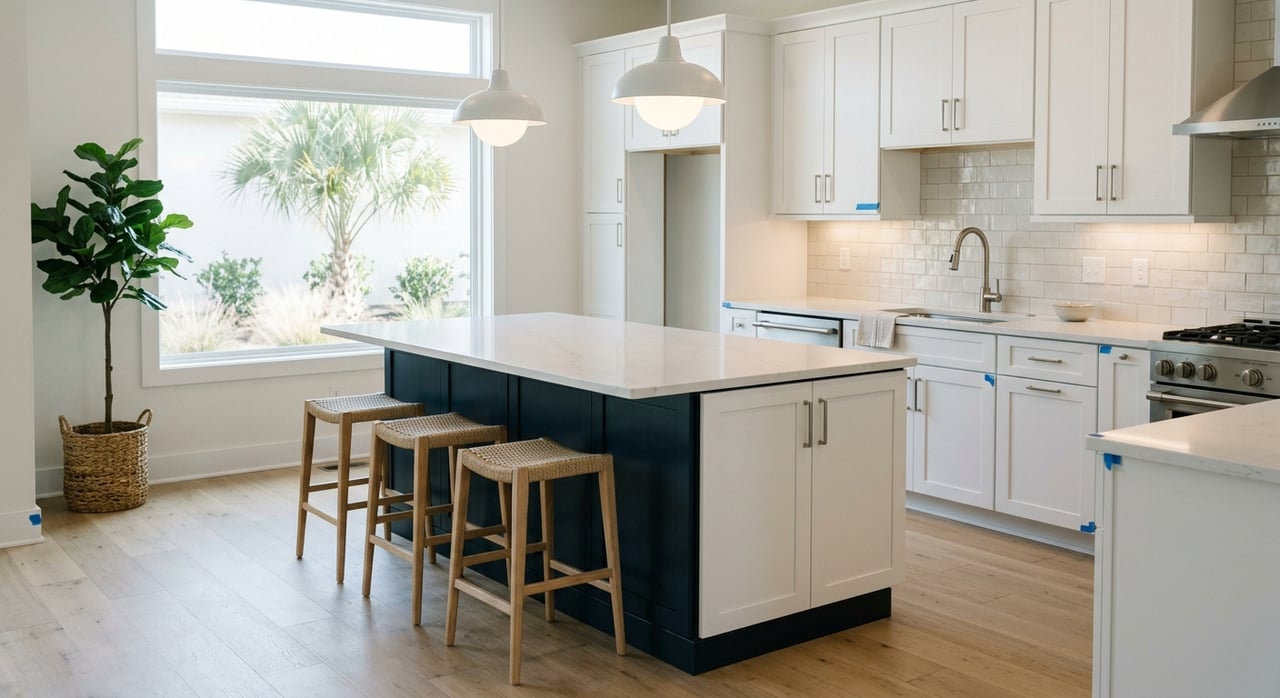
New Construction In Carolina Forest: How To Shop Smart
May 7, 2026
May 7, 2026
Buying new construction in Carolina Forest can feel simple at first. You pick a floor plan, tour a model, and imagine an easy path to closing. But once you look closer, the real decisions show up in the details: location within Carolina Forest, builder incentives, lot premiums, upgrade costs, timing, and contract terms. If you want to shop smart, you need more than a pretty model home. You need a clear plan. Let’s dive in.
Carolina Forest works best as a growth corridor, not just one neighborhood. That matters because your experience can change a lot depending on which pocket of the area you choose.
Horry County has completed widening Carolina Forest Boulevard to River Oaks Drive, and county plans also call for a new SC 31 interchange at Augusta Plantation Drive and Revolutionary War Way. Those improvements are designed to improve connectivity and reduce congestion, but commute patterns and access still vary by community.
For many buyers, that is the appeal of Carolina Forest. You can find newer homes, active development, and communities with amenities, while staying connected to Highway 501, Highway 31, and the beach. At the same time, not every neighborhood offers the same day-to-day convenience, so location inside Carolina Forest matters just as much as the home itself.
Before you compare builders, narrow down the part of Carolina Forest that fits your routine. A home that looks perfect on paper may feel very different once you consider traffic flow, nearby road access, and how often you plan to drive toward Myrtle Beach, Conway, or other parts of the Grand Strand.
Some communities are marketed around quick access to major routes. Indigo Bay, for example, sits on Carolina Forest Boulevard with access to 501, 31, and 17. Waterbridge and Ridgefield are also positioned around the same broader corridor.
That does not mean every drive will feel the same. In a growing area, two communities can be close on a map but function differently in real life. If you are relocating or buying a second home, this is one of the smartest things to test early.
Carolina Forest gives you several new-construction options, but they are not all built around the same buyer experience. Some builders lean on broad included-feature packages, while others make personalization a bigger part of the process.
D.R. Horton’s Waterbridge offers one- and two-story plans with features like flex rooms, walk-in closets, and first-floor guest or primary suites. The builder also highlights smart-home features and resort-style amenities including a clubhouse, pool, fitness center, tennis, pickleball, basketball, volleyball, and bocce.
Ridgefield, also from D.R. Horton, is positioned between US-501 and SC-544 and offers 3- to 5-bedroom plans from 1,475 to 2,713 square feet. The community includes a clubhouse, fitness center, playground, and pool.
Pulte’s Indigo Bay is a gated community with 63 homesites and a 50-acre lake. Amenities include a clubhouse, pool, fitness center, dog park, tennis, pickleball, and walking trails, with current pricing on the builder page starting at $524,990+.
Lennar’s Hidden Pines is off Highway 501 and shows homes starting at $421,000 on its current page. It lists included features such as stainless-steel appliances, upgraded cabinetry, granite countertops, subway tile backsplash, low-E windows, smooth ceilings, and a tankless water heater.
Mungo Homes’ North Cove is a coming-soon community in the Carolina Forest school zone, with floor plans from 1,693 to 2,808 square feet and future planned amenities including a cabana and pool.
One of the biggest mistakes buyers make is comparing only the advertised starting price. In new construction, the real number usually comes from three separate buckets.
This matters because two homes with the same floor plan can end up far apart in total cost. A premium lot, added porch, extra garage space, upgraded kitchen package, or design-center selections can shift the final number fast.
Lennar is a good example of an included-features model. Hidden Pines lists many features at no extra cost, including stainless appliances, upgraded cabinetry, granite countertops, subway backsplash, 9-foot first-floor ceilings, low-E windows, and a tankless water heater.
Mungo takes a more design-center-driven approach. Its process includes an under-contract design appointment where buyers can select cabinets, flooring, countertops, lighting, and paint, among other finishes.
Pulte’s Indigo Bay shows another version of the same pattern. The base product is already strong, but many plans show options like a guest suite, study, screened porch, or fireplace. In practice, that means lot choice and structural changes often drive price just as much as the floor plan itself.
In Carolina Forest, active inventory can change quickly. A community that looks available during your online search may be nearly sold out, temporarily sold out, or not yet fully released.
For example, Lennar’s Victory Point is currently shown as temporarily sold out, while North Cove is still coming soon. That is why it is important to confirm live availability before you build your search around one subdivision.
If you are on a tighter timeline, ask which homes are already under construction and which are available for a faster closing. If you have more flexibility, you may have better luck with a to-be-built option or an early-phase release.
Builder incentives can look generous, but the headline offer is not always the full story. In many cases, the savings are tied to a specific home, a specific lender, and a short contract window.
Recent Myrtle Beach-area promotions show how this works. Lennar has advertised offers such as up to a $40,000 price reduction, up to $7,500 toward closing costs, and up to $5,000 in flex credit on select homes, with some benefits requiring Lennar Mortgage. Pulte has also advertised closing-cost savings tied to Pulte Mortgage Finance, plus a Hometown Heroes discount on select homes.
D.R. Horton’s Waterbridge page highlights a limited-time special interest-rate opportunity on certain homes. The pattern is consistent: incentives change by community, inventory, and financing terms.
The smartest comparison is usually net price, not the biggest headline discount. That is especially true when you are comparing a builder home against resale or another community nearby.
If you are financing your purchase, state-level buyer programs may be worth exploring. South Carolina Housing says Palmetto Home Advantage is available in all 46 counties and can be used by first-time, move-up, and repeat buyers.
SC Housing also notes that the program offers forgivable down-payment assistance options, with no sales price limits and a statewide income limit. Its first-time-buyer program may also include fixed-rate mortgage options with down-payment help.
For some buyers, that can make a new home more workable than expected. The key is to compare any state program with builder financing incentives carefully so you understand which option creates the better overall outcome.
A new home is not the same as a risk-free home. Even in a brand-new property, inspections, licensing checks, and a clear understanding of the process all matter.
South Carolina requires residential builders to be licensed, and the LLR Residential Builders Commission maintains a license lookup. Buyers should verify the actual builder entity on the license record, not just the community or sales office name.
South Carolina also licenses home inspectors. The state defines a home inspection as a report on visible and readily accessible conditions in a residence, which is why timing matters so much in new construction.
A standard final walkthrough is still important, but it is not the same as an independent inspection. Once walls are closed, hidden conditions are harder to evaluate.
Mungo’s published process offers a useful checklist for what a well-run build can include: a pre-construction meeting, a pre-drywall meeting, a final orientation, and a homecoming meeting immediately before closing. Mungo also notes that changes are not allowed after the pre-construction meeting, which is a good reminder to finalize your structural and finish choices early.
Warranty coverage can vary by builder, so do not assume every new home comes with the same protections. Ask for the actual warranty booklet and review what is covered, what is excluded, and how warranty requests are handled after closing.
D.R. Horton publishes a warranty structure that includes one-year coverage for workmanship and materials, two-year coverage for plumbing, electrical, and HVAC systems, and ten-year coverage for major structural defects. Pulte advertises a 10-year limited structural warranty, and Mungo says its warranty partner offers up to a 10-year warranty.
That sounds reassuring, but the details matter. A smart buyer looks past the headline term and focuses on how service claims are submitted and what responsibilities remain with the homeowner.
If you are choosing between Carolina Forest new construction and a higher-end resort setting like Grande Dunes, the decision often comes down to priorities. Carolina Forest is usually the more value-oriented path for buyers who want newer systems, builder choice, and amenity-rich communities at a lower entry point.
Grande Dunes sits in a more premium resort-luxury tier. It is a 2,200-acre master-planned community with private beach access, championship golf, a marina, tennis, and the Ocean Club. Toll Brothers’ Cascadia at Grande Dunes currently starts at $799,995, while Carolina Forest-area examples in the research range from the mid-$300s at Ridgefield and North Cove to the low $500s at Indigo Bay and about $421,000 at Hidden Pines.
For many relocators and second-home buyers, this is the real trade-off. Do you want the efficiency and value of a new build in a fast-growing corridor, or are you looking for a more established resort environment with a deeper luxury amenity package?
Neither answer is automatically right. The smart choice is the one that fits your budget, your timeline, and how you want to live on the Grand Strand.
If you want help comparing Carolina Forest new construction against other Myrtle Beach and Grande Dunes options, working with a local advisor can save you time and help you see beyond the sales office pitch. For concierge-level guidance across the Grand Strand, connect with Lindsay Jones.
Stay up to date on the latest real estate trends.
Lindsay is dedicated to helping you find your dream home and assisting with any selling needs you may have. She values the trust clients place in her and works tirelessly on their behalf to offer attention to detail for each transaction. Contact her today so he can guide you through the buying and selling process.